The Push Notification Problem Nobody Is Talking About
More than half of push notifications are delivered while the phone is sitting unattended on a table. Looking at billions of mobile events, we found that context often matters more than send time - because the best notification is useless if nobody is there to see it.



Introduction
The mobile industry has spent years getting better at push notifications. Better copy. Better timing models. Better segmentation. Send to the right person, at the right time, with the right message.
The open rates kept falling anyway.
There's a reason for that. And it has nothing to do with copy or segmentation.
The phone is there. The person isn't.
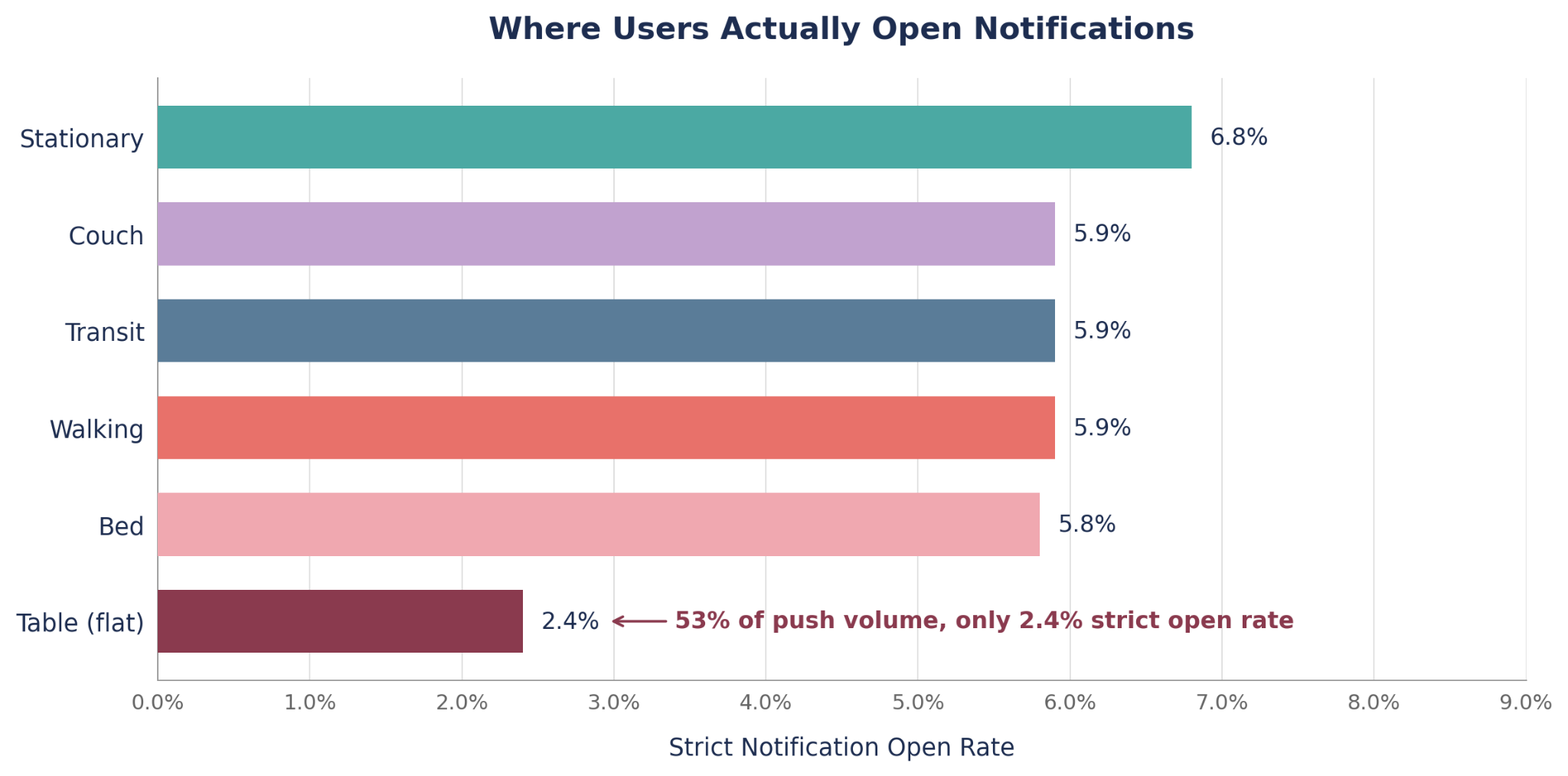
We analyzed where users actually are when push notifications land. The finding is uncomfortable: 53% of notifications are delivered while the phone is flat on a table.
Not in someone's hand. Not in their pocket. Flat on a surface, screen down or screen idle, while the person is doing something else entirely. Eating dinner. In a meeting. Asleep.
The notification arrived. Nobody saw it.
And the data confirms this isn't just a delivery problem - it's a conversion problem. Strict open rates when the phone is flat on a table run 2 to 3x lower than when users are stationary and upright, or on the couch. The context the notification lands in predicts whether it gets opened more reliably than almost anything else being optimized for right now.
The industry is solving the wrong problem
Delivery-time optimization asks: when is this user usually awake and reachable? It looks at historical open windows, finds the times a user has opened notifications before, and sends into those windows.
This is a reasonable approach. It's also solving the wrong problem.
"Usually awake and reachable" and "currently holding their phone in a receptive state" are different conditions with different answers. A user who historically opens notifications at 8pm might be cooking dinner at 8pm tonight. The historical pattern is real. The receptivity in this specific moment is not.
The question that actually predicts whether a notification lands isn't when - it's what state is this person in right now.
What receptivity optimization looks like
The shift isn't dramatic. It doesn't require rebuilding your notification infrastructure. It requires adding one signal that most systems currently ignore: is this person actually in a position to receive this message right now?
A notification deferred by ten minutes - from a moment when the phone is flat and unattended to a moment when the user picks it up and is moving - is not a worse notification. It's a better one. Same message. Same user. Different state.
Deferring delivery to high-attention moments is one of the largest single levers we've observed in notification performance. The message doesn't change. The moment it arrives in does.
Most push strategies are optimized around a user model that treats all delivery moments as equivalent. They are not. The phone on the table during dinner is not the same delivery surface as the phone in the hand of someone who just sat down. The gap between those two moments explains a meaningful portion of the gap between notification delivery rates and notification action rates.
The infrastructure to know the difference exists. It's been sitting in the device sensors the whole time.