We analyzed billions of mobile sessions. Here's what users are actually doing when they convert.
Most mobile analytics tell you what users did. We analyzed billions of mobile sessions and found that what users are doing in the real world - sitting at a table, lying in bed, commuting or walking - often explains engagement better than traditional behavioral data.


Introduction
Two users open the same app on a Tuesday evening. Same age, same country, same plan, same spending history. One taps through to upgrade. One closes the app within fifteen seconds.
Traditional analytics will tell you almost nothing about why.
It will tell you who they are. It will reconstruct their funnel, segment them into cohorts, recommend an A/B test. What it won't tell you is the one thing that might actually explain the difference: one of them was sitting at a kitchen table with a coffee. The other was half-asleep, holding their phone above their face, about to drift off.
This is the missing layer. And we think it explains a lot.
The industry got obsessed with who and forgot to ask what
For fifteen years, mobile product teams have been refining their understanding of users along one axis: identity. Demographics, behavioral cohorts, LTV bands, retention curves. The implicit bet was that if you knew enough about who someone was, you could predict what they'd do.
It's a reasonable bet. It's just incomplete.
Because the same person, at different moments of their physical day, is functionally a different user. A user on the subway is not a user at a kitchen table. A user in bed at 11pm is not the same person as that same user, in that same bed, at 7am. We've been treating these as the same data point. They are not.
We set out to layer real-world context signals on top of standard mobile analytics - and what we found changes how we think about session quality, notification delivery, and conversion depth.
Here are three things that showed up consistently:
1. Session length is not a user quality trait. It's an attention window.
A user at a table has a median session duration of 9.3 minutes. In bed, that number drops to 3.8 minutes. Same user, same app, different room - 2.4x difference in available attention.
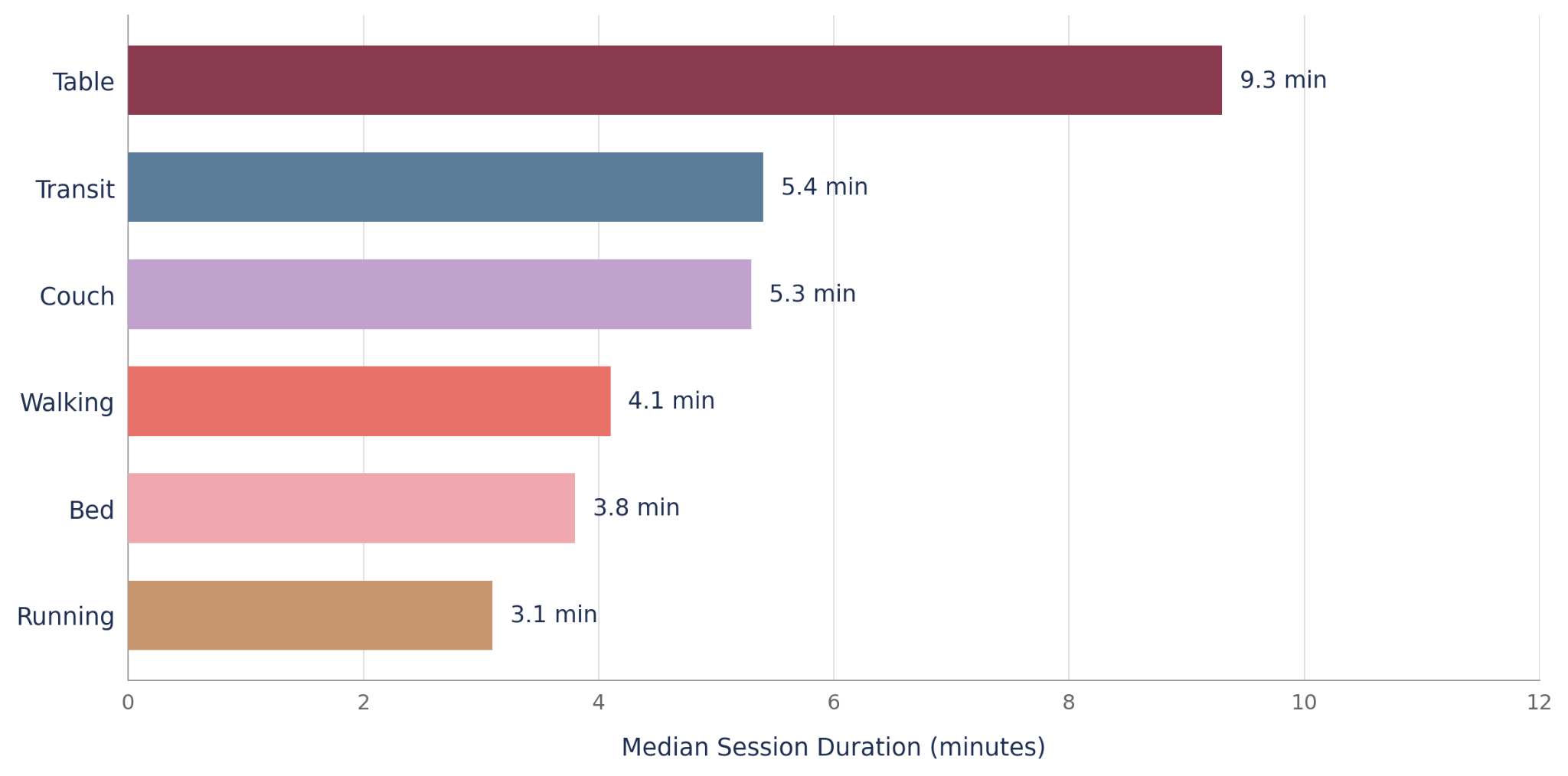
This matters because most apps treat session length as a signal of user quality. High session time = engaged user = worth investing in.
But what the data actually shows is that session length is largely a function of physical context, not intent. The "low engagement" user opening your app in bed isn't disengaged - they're just in bed. Show them the same long, attention-demanding onboarding flow you'd show a user at a desk and you've already lost them.
The practical implication: content depth should be calibrated to context. A user at a table can handle a detailed tutorial, a complex offer, a multi-step paywall. A user in bed needs something that fits a 3-minute window.
These are not the same product moment and they shouldn't be treated as one.
2. Half your push notifications are landing on phones nobody is holding.
53% of push notifications are delivered while the user's phone is flat on a table. Strict open rates in that context are 2 to 3x lower than when users are sitting upright, on the couch or in transit.
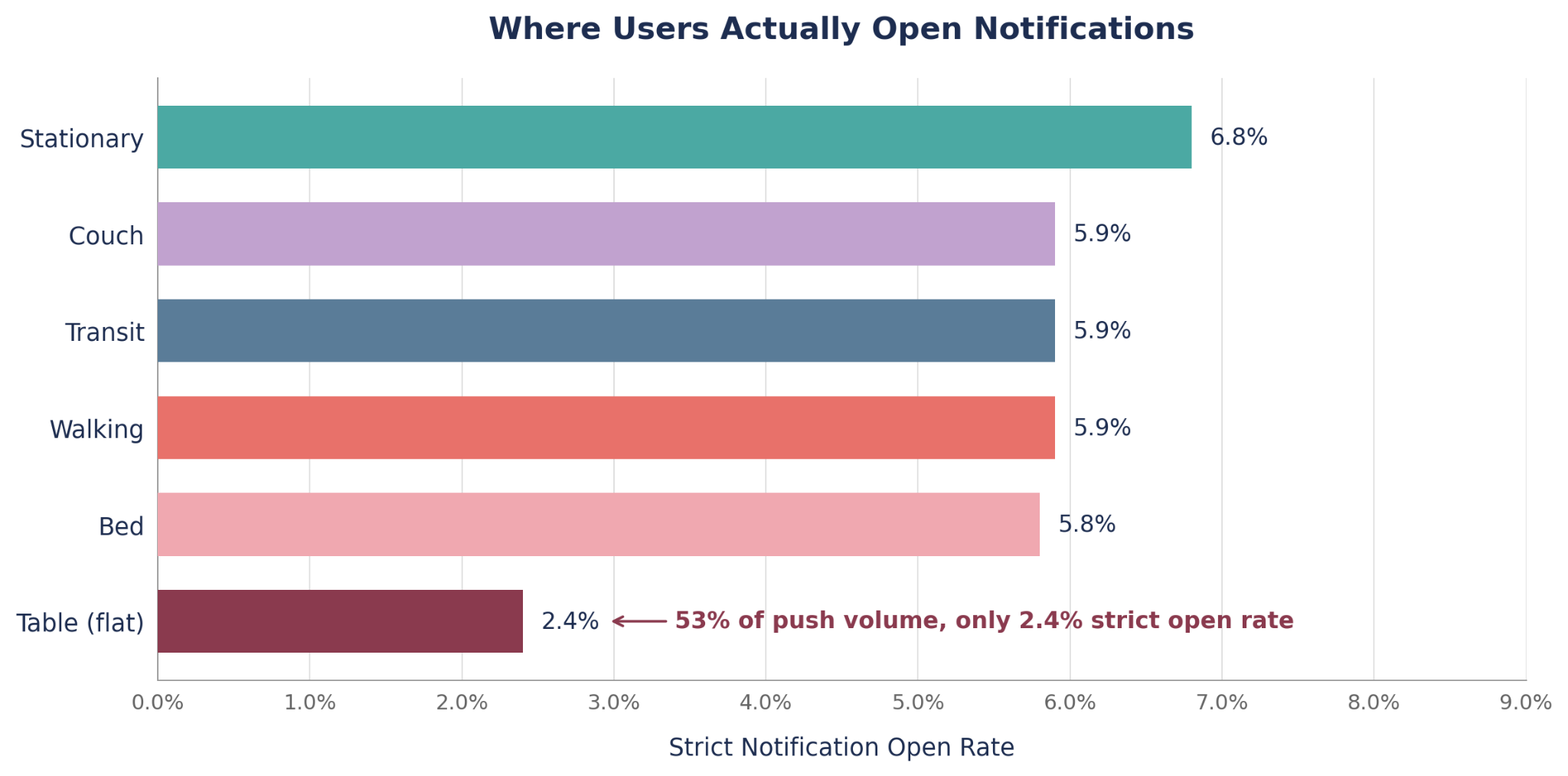
This is not a small inefficiency. This is the majority of your push volume going out at moments when the person on the other end is almost certainly not there. Dinner. A meeting. Asleep with their phone on the nightstand.
The industry has spent years optimizing notification delivery around time of day - send when users are "usually awake." That's a rough indicator for a much more precise signal: is this person actually holding their phone right now? Those are different questions with different answers and only one of them correlates with whether your message lands.
Moving from delivery-time optimization to receptivity optimization with ContextPush is probably the single largest untapped lever in push notification performance.
3. The deeper users go, the calmer their context.
Search is the universal entry action. Users in every context open apps and start searching. But what happens next depends heavily on where they are.
Users in rest contexts - bed, couch, table - are 46% more likely to reach a detail view after searching than users who are walking or in transit. By the time someone reaches that detail page, the share of users in a rest context has jumped from 22.9% to 35.9%.
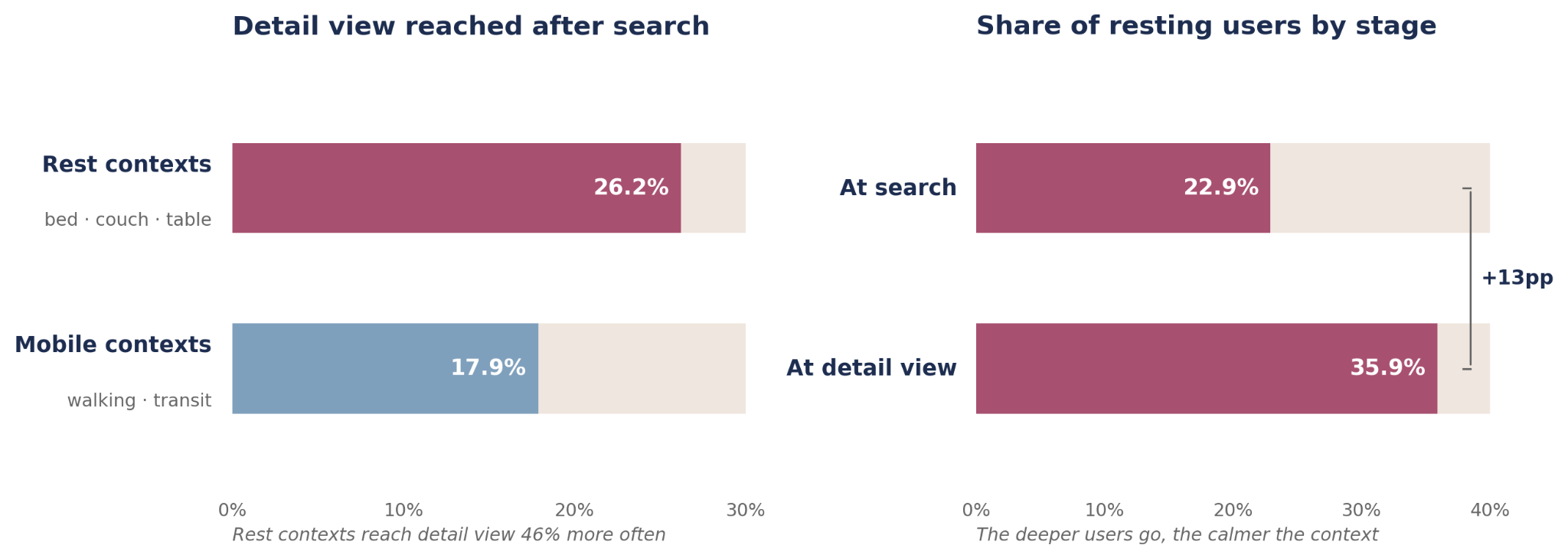
The interpretation: physical stillness is a prerequisite for depth. Users on the go engage with the surface of your app. Users at rest go further. This means conversion is not just a function of what you show - it's a function of whether the person in front of you is in a state where they can go deep at all.
Showing your most important product moment to a user mid-commute isn't just suboptimal. It's a structural mismatch between what you're asking and what the moment allows.
What this adds up to
None of this is about demographics. It's not about cohorts or LTV bands or behavioral segments. Two users in the same segment, at the same moment in their funnel, can be in completely different physical states - and that state predicts what they'll do next more reliably than almost anything else you're currently measuring.
Importantly, this doesn't mean table sessions are always better than bed sessions.
In some social and entertainment apps we've analyzed, bed is actually one of the highest-engagement contexts.
What surprised us wasn't a specific context winning.
It was how consistently we found a gap between discovery contexts (where users open an app) and engagement contexts (where they actually spend time, explore, and convert).
The place where users first interact with a product is often not the place where they engage most deeply with it.
The person on the subway is not the person at the kitchen table. The app that figures out the difference first is going to win their category.
Context is available now. Most teams just aren't looking at it yet.