Stop Optimizing the Past: Why Real-Time Decisions Matter More Than Perfect Reports
Most teams use AI to explain what already happened. The real leverage in 2026 is deciding when to act - not just what to analyze.



Introduction
For years, growth teams have optimized for one thing above all else: better reporting.
Faster dashboards. Cleaner breakdowns. Smarter AI assistants that can summarize yesterday’s performance in seconds instead of hours.
And according to the AppsFlyer State of Gaming for Marketers - 2026 Edition, this is exactly how most teams are using AI today:
46% of AI assistant queries focus on reporting and performance breakdowns.
That makes sense. The volume of data exploded. Creative variations multiplied. Channels fragmented. AI became the only way to keep up.
But here’s the uncomfortable truth:
Reporting only explains what already happened.
The real leverage in 2026 is deciding what to do next - in the moment.
The Reporting Trap: Fast Insights, Slow Decisions
The AppsFlyer data shows a clear pattern across genres:
- Hypercasual teams spend over 50% of AI queries on reporting and speed
- Midcore and Casino teams go deeper, allocating more queries to explaining changes and anomaly diagnosis
- Very few teams use AI primarily to decide when to act
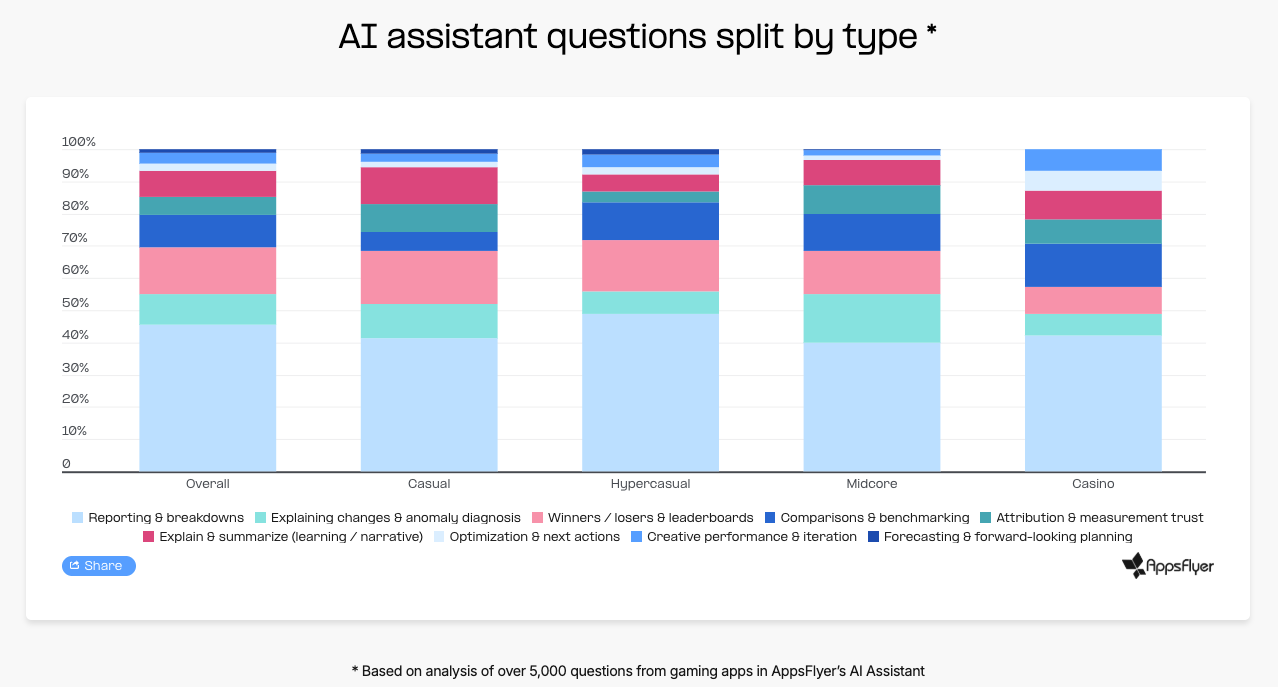
This reveals a structural bias in how the industry operates.
We’ve optimized the analysis layer, but left the decision layer mostly static.
Most apps still rely on hard-coded logic like:
- Show onboarding on first launch
- Trigger a paywall after X actions
- Send a push after Y hours of inactivity
No matter what the user is actually doing.
The Real Bottleneck Isn’t Insight. It’s Timing.
The report makes another thing very clear: attention is the new bottleneck.
- Paid install share increased 10% YoY
- Ad impressions surged 20% YoY
- Creative production scaled to 2,400-2,600 variations per quarter for top spenders
Everyone can build faster. Everyone can test more. Everyone can see results sooner.
But the audience didn’t grow.
So winning is no longer about what you show.
It’s about when you show it - or when you stay silent.
A perfect message delivered at the wrong moment still fails.
Acting in the Moment Beats Explaining the Past
This is where most reporting-driven stacks fall short.
Dashboards can tell you:
- A paywall converted poorly
- A push notification underperformed
- Engagement dropped at a specific hour
What they can’t tell you is why.
Was the user:
- Walking between meetings?
- Commuting with one hand on the phone?
- Low on battery?
- Distracted, rushed, or multitasking?
Traditional analytics treat all of these moments as identical.
They aren’t.
From Analytics to Action: Where ContextSDK Fits
This is where most reporting-driven stacks fall short.
Dashboards and AI assistants are great at summarizing outcomes. But they still operate after the moment has passed. They explain performance - they don’t shape it.
ContextSDK takes a different approach to AI.
Instead of using AI in the cloud to analyze historical data, ContextSDK uses on-device AI (Edge AI) to understand a user’s real-world situation as it happens. By processing hundreds of signals directly on the device - motion, device state, connectivity, usage patterns and more - ContextSDK determines whether a user is actually receptive right now.
The question shifts from
“What happened?”
to
“Is this a good moment to act at all?”
This enables a move from static, rule-based logic to real-time, moment-based decisions:
- Onboarding adapts based on whether a user is focused or distracted
- ContextDecision shows paywalls or offers only during high-receptivity moments
- ContextPush sends notifications when users are actually available, not just inactive
Same funnels. Same products.
But decisions are made in the moment, not after the fact.
Why This Matters More Than Better Reports
The AppsFlyer report highlights a paradox of 2026:
AI made production, testing, and reporting cheap.
But decision quality is now the true competitive advantage.
Teams that only optimize faster reporting will:
- Explain churn better
- Diagnose drops quicker
- Justify decisions more convincingly
Teams that optimize real-time decisioning will:
- Interrupt users less
- Convert more with fewer attempts
- Preserve attention in ad-heavy, competitive markets
One explains the past.
The other shapes the future.
The Shift Growth Teams Need to Make
The takeaway from the State of Gaming report isn’t “use AI more.”
It’s this:
Stop using AI only to understand what already happened.
Start using intelligence to decide when to act, ask or stay silent.
Context-aware decisioning is how you turn insights into outcomes.
Because in a market flooded with data, creatives, and automation,
timing is the only signal competitors can’t easily copy.