When Better Paywalls Stop Working: Why Timing Is the New Conversion Lever
Everyone is testing paywalls at scale now. But even the best design fails if the moment is wrong. The next conversion lever isn’t what you show - it’s when you show it.



Introduction
For years, paywall optimization was a design problem.
Better copy.
Smarter pricing anchors.
More emotional headlines.
Cleaner layouts.
And now, with AI-powered tools, all of that has become radically cheaper.
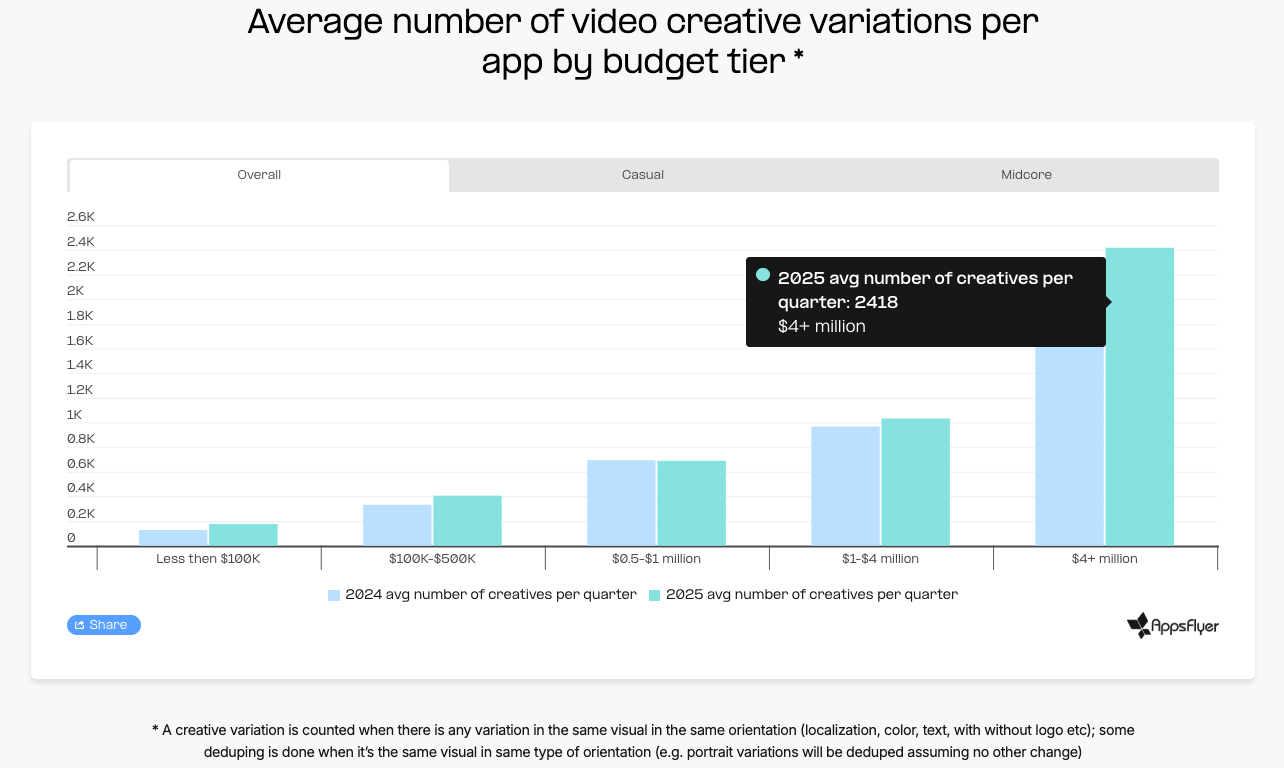
According to the AppsFlyer State of Gaming for Marketers - 2026 Edition, top gaming advertisers now produce 2,400-2,600 creative variations per quarter, up 25-30% YoY. Smaller teams scaled output by 20-40%, using AI to close the gap. Testing visuals, messaging and pricing has never been easier or faster.
But something unexpected happened.
Despite better designs and more testing, conversion rates didn’t magically scale with them.
Because design was never the real bottleneck.
Creative Abundance, Attention Scarcity
AppsFlyer’s data makes one thing painfully clear:
attention did not grow with creative output.
- Paid install share increased 10% YoY
- Ad impressions surged 20% YoY
- Creative production exploded across every budget tier
Yet users didn’t suddenly have more time, focus, or patience.
The industry solved how to build and test faster.
It did not solve when to show things.
This is the silent reason many “winning” paywalls still underperform.
Why Even the Best Paywall Fails at the Wrong Moment
Most paywalls still operate on static logic:
- Show after onboarding
- Show after X actions
- Show after Y minutes
This logic assumes all moments are equal.
They aren’t.
A user seeing a beautifully designed paywall while:
- commuting
- walking
- multitasking
- low on battery
- distracted or rushed
is fundamentally different from a user seeing it:
- at home
- stationary
- focused
- with time to explore
Traditional A/B testing treats these as identical impressions.
Users don’t.
So teams redesign copy, tweak prices, and rerun tests - while the real issue is timing.
AI Made Design Cheap. It Didn’t Make Decisions Smarter.
The AppsFlyer report shows how AI is currently used across gaming teams:
- 46% of AI assistant queries focus on reporting and breakdowns
- Hypercasual teams prioritize speed and visibility
- Midcore and Casino teams dig deeper into explanations and anomalies
What’s missing?
AI is rarely used to decide when to act.
We’ve automated production.
We’ve accelerated analysis.
But most decision logic inside apps is still hard-coded and context-blind.
From “What Works” to “When It Works”
This is where paywall optimization needs to evolve.
Instead of asking:
- Which copy converts better?
- Which price point performs best?
The more powerful question becomes:
- In which moments should we show anything at all?
That shift changes everything.
Where ContextSDK Changes the Game
ContextSDK adds a missing layer to paywall and creative optimization: real-world timing.
Using on-device AI (edge AI), ContextSDK analyzes hundreds of privacy-safe signals directly on the phone - including motion, device state, connectivity, and usage patterns - to understand a user’s current moment.
Not who they are.
Not where they’ve been.
But whether they are receptive right now.
This allows apps to:
- Show paywalls only during high-attention moments
- Delay offers when users are distracted or in motion
- Adapt monetization flows without changing the paywall itself
Same designs.
Same copy.
Better outcomes.
Timing Is the Multiplier AI Can’t Fake
In a market where:
- everyone can generate creatives
- everyone can test copy
- everyone can analyze results faster
timing becomes the only lever that doesn’t scale automatically.
And that’s exactly why it matters.
The next wave of paywall optimization won’t be won by prettier screens.
It will be won by respecting user attention.
Because even the perfect message failsif it arrives at the wrong moment.