The Moment Matrix: Why Your Paywall Strategy Needs Four Modes, Not One
Your paywall triggers after 3 sessions. Cool. But is the user walking or sitting? Multitasking or focused? Traditional analytics don't tell you. The Moment Matrix does - matching your monetization strategy to real-world context.



Introduction
Most apps treat every moment the same.
User opens the app at 6am while brushing their teeth? Show the paywall. User settles in on the couch at 9pm? Show the paywall.
One converts at 3%. The other converts at 14%.
Your A/B test averages them into "7.2%" and calls it progress.
This is the invisible tax on every paywall you're running.
The Problem: One Strategy for Four Different Contexts
Not all app opens are equal. But most paywall systems act like they are.
They trigger based on:
- Session count
- Time in app
- Feature interactions
- Progression milestones
All useful signals. None of them tell you if the user is actually receptive right now.
That's why we built The Moment Matrix - a simple framework for matching your monetization strategy to real-world user context.
The Moment Matrix
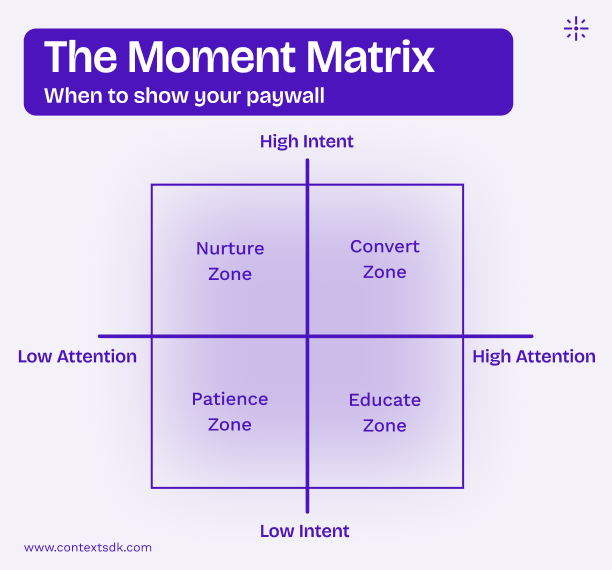
The matrix maps two critical dimensions:
- Attention: Is the user focused or distracted?
- Intent: Does the user want what you're offering?
This creates four distinct zones - each requiring a completely different approach.
CONVERT ZONE
High Attention × High Intent
What's happening: The user is stationary, focused, actively exploring premium features, and has extended session time. Stable connection. Decent battery. This is your moment.
What to do: Show your full paywall
✅ Lead with value, not just price
✅ Multiple tiers and options
✅ Social proof and testimonials
✅ Longer copy works here
Why it works:
The user has time, focus and motivation. This is where your carefully designed paywall actually pays off. Don't hold back.
NURTURE ZONE
Low Attention × High Intent
What's happening: The user wants to upgrade but they're moving, multitasking or dealing with a poor connection. High intent, terrible timing.
What to do: Delay the paywall entirely
✅ Log the intent signal
✅ Re-engage later via push notification
✅ If you must show something: one-tap simplified option only
✅ "Remind me tonight" as primary CTA
Why it works:
Forcing a decision now kills conversion and trains users to ignore your offers. Respect the moment. Reach them when they can actually act.
This is ContextPush territory - intelligently timed notifications that arrive when users are stationary and receptive.
EDUCATE ZONE
High Attention × Low Intent
What's happening: The user is stationary and focused, but they're exploring, not committed. Early in their journey. Curious but not sold.
What to do: Soft paywall or feature preview
✅ Highlight value, not price
✅ Show what they're missing (demo mode)
✅ Low-friction "Learn More" path
✅ No hard pressure
Why it works:
They have time but aren't ready to buy. This moment is about building desire, not extracting payment. Educate first. Convert later.
PATIENCE ZONE
Low Attention × Low Intent
What's happening: The user is distracted, passively browsing or showing low engagement signals. Fleeting session. Not the moment.
What to do: Don't show the paywall ❌
✅ Let them explore freely
✅ Optimize for retention, not revenue
✅ Log the session for later analysis
Why it works:
Showing a paywall here doesn't just fail to convert - it actively annoys users. You're burning future opportunities for zero gain. Be patient. Wait for a better moment.
What This Looks Like in Practice
Before: Show paywall after 3 sessions, regardless of context
After: Show paywall after 3 high-attention sessions
Before: Trigger paywall when user hits feature limit
After: Trigger paywall when user hits limit and is in Convert Zone
Before: Paywall appears at 5 minutes into session
After: Paywall appears when session is focused and user is stationary
Same paywall design. Same pricing. Better moment.
Why Most Teams Miss This
Traditional analytics tell you:
- How many times a user opened the app
- Which features they used
- How long they stayed
They don't tell you:
- Whether the user was walking or sitting
- If they were multitasking or focused
- If they had time to make a decision
Your A/B test compares Variant A vs. Variant B.
It doesn't compare Good Moment vs. Bad Moment.
So you keep redesigning the paywall when the real issue is timing.
The Shift: From "What Converts" to "When to Show It"
Creative testing tells you what works.
Context intelligence tells you when to show it.
You need both.
Because the best paywall in the world still fails at the wrong moment.
How ContextSDK Makes the Moment Matrix Real
The Moment Matrix isn’t a thought exercise.
It’s exactly the decision layer ContextSDK was built to power.
ContextSDK adds real-world context to moments where traditional analytics go blind. Instead of guessing based on sessions or events, ContextSDK understands what’s happening around the user right now.
Using on-device, privacy-safe signals like:
- Motion and device orientation
- Screen state and session stability
- Connectivity and battery conditions
- Short-term attention patterns
ContextSDK determines whether a user is focused, distracted, stationary or in motion - in real time.
No cloud profiling. No identifiers. No historical assumptions.
Why ContextDecision Solves the Paywall Timing Problem
ContextDecision sits directly at the moment of action.
Instead of asking “Has the user hit the trigger?”
it asks “Is this a good moment to ask anything at all?”
That’s how the Moment Matrix becomes executable:
- Convert Zone → ContextDecision greenlights the full paywall
- Nurture Zone → Paywall is delayed, intent is logged, re-engagement is scheduled
- Educate Zone → Lightweight value previews replace hard asks
- Patience Zone → Monetization is skipped entirely
Same user. Same paywall.
Different moment. Different outcome.
The Real Upgrade Isn’t the Paywall. It’s the Timing.
Most teams keep iterating on:
- Copy
- Pricing
- Layout
- Visual hierarchy
All important. None sufficient on their own.
ContextDecision changes the optimization question from:
“Which paywall converts best?”
to:
“When should we show anything at all?”
That shift alone is often worth more than the next five redesigns combined.
Because in the end, conversion isn’t a UI problem.
It’s a moment problem.
And moments are exactly what ContextSDK is built to understand.